
If you have ever worked on a grant proposal or funder report, you have probably run into some version of this question: What outcomes will/did this program achieve? It sounds straightforward enough, but it has long been a source of major stress and confusion for nonprofits, especially small ones without dedicated measurement and evaluation support.
Outputs and Outcomes are Not the Same Thing
One of the most common sources of confusion is understanding the difference between outputs and outcomes. This is because outcomes can mean different things depending on who is asking, what they are funding, how much time has passed, and what kind of change is actually realistic to observe.
Sometimes funders are asking about immediate changes. Other times, they are asking about long-term impact. Sometimes they are really asking for outputs, even if they use the word “outcomes.” And sometimes, especially in a competitive grant process, organizations feel pressure to describe big, ambitious changes, such as increased educational attainment, improved economic security, or long-term community well-being, before they have the time, resources, or data systems to measure those changes well. That is a lot to ask from one little word, and it’s a big part of the reason why outcome language often feels so overwhelming.
To better understand the distinction, it helps to think of it like this:
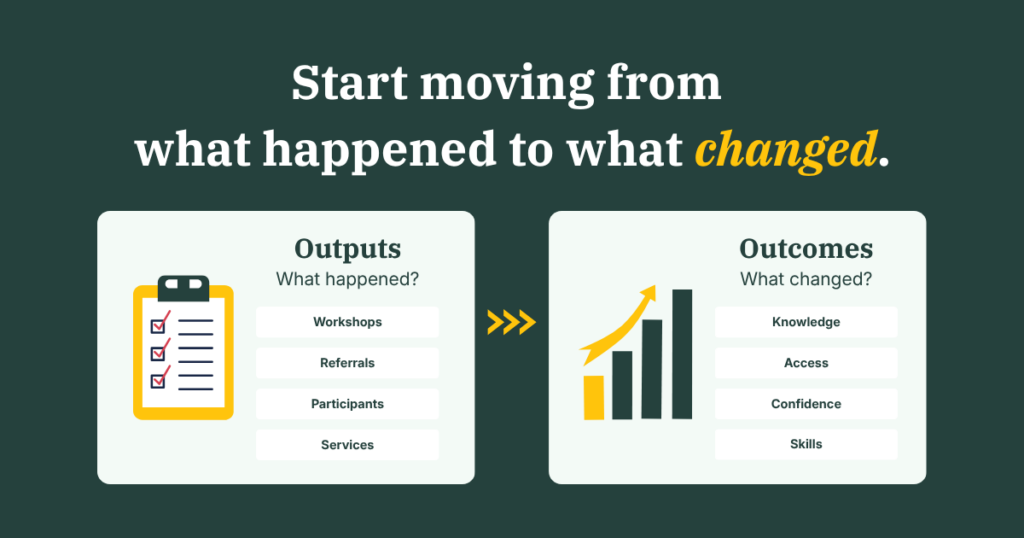
Outputs are the things your organization does or produces. They are usually countable and answer questions like:
- How many people participated?
- How many workshops were held?
- How many meals were served?
- How many coaching sessions were provided?
- How many referrals were made?
- How many families received support?
Outputs matter in the context of mission-driven work, because they show reach, activity, and effort, which helps funders understand the scale of the work and whether the organization did what it said it would do. But outputs are not the same as outcomes.
Outcomes are the changes that happen because of the work. They answer questions like:
- What changed for participants?
- What did people learn?
- What skills did they build?
- What access did they gain?
- What decisions were they able to make?
- What barriers were reduced?
- What became more possible because of the program?
For example:
- A workshop is an output. Increased knowledge is an outcome.
- A referral is an output. Improved access to services is an outcome.
- A mentoring session is an output. Increased confidence, connection, or persistence may be outcomes here.
A challenge many small nonprofits face when trying to measure their impact is that, while funders are asking them to report outcomes, the systems they are most likely to have in place tend to track outputs. That is often because smaller organizations are working with limited staff time, limited technology, and limited funding for evaluation support. They may have enough capacity to count participation, services, and activities, but not enough infrastructure to consistently follow up with participants, analyze change over time, or connect data across multiple programs.
That does not mean the organization is doing anything wrong or does not understand the importance of tracking outcomes. It means the measurement system may need to be adjusted so it can capture not only what happened, but what changed. Yet, many small nonprofits have not had access to the right kind of guidance and support to make that shift in a way that is realistic and sustainable. That is also why I founded Measured for Good.
Funders are Often Trying to Understand the "So What?" Question
When funders ask about outcomes, they are usually just trying to understand the difference the work is expected to make. In other words: You are doing these activities. So what changes because of them?
That “so what?” question may sound a little blunt, but it is also a fair one. Funders deserve to know whether their investment is connected to meaningful change, and organizations need to know that, too. The key is to answer the question in a way that fits the program, the timeline, and the organization’s actual capacity.
For example, if an organization is running a six-week financial literacy workshop, it may be reasonable to measure whether participants increased their knowledge, confidence, or ability to create a basic budget. It would not be reasonable to claim that the workshop directly increased financial stability or homeownership among participants shortly after completion or even within the reporting confines of a one-year grant cycle. While those may be meaningful long-term goals, they are not outcomes the organization can credibly measure right away and probably without much external support.
This is where right-sized evaluation comes in. It helps ensure organizations have useful outcomes, not just impressive sounding ones, by making sure they are clear, realistic, directly connected to the work, and possible to observe within the timeframe of the program or grant.
Not All Outcomes Happen at the Same Pace
Another reason outcomes can feel confusing is that social change happens over different timeframes.
Some outcomes are short-term. These are changes that may happen during or soon after a program, such as:
- Increased knowledge
- Increased confidence
- Stronger awareness of available resources
- Improved understanding of next steps
- Increased connection to supportive adults or peers
- Greater readiness to take action
Other outcomes are intermediate. These usually take more time to observe. Examples might include:
- Applying new skills
- Following through on a plan
- Accessing services
- Improving attendance or engagement
- Strengthening relationships
- Making more informed decisions
- Reducing a specific barrier
Then there are long-term outcomes. These are often the bigger changes boards and funders tend to care about most, but they usually take much longer to observe and may be influenced by many factors outside the program. These might include:
- Improved economic mobility
- Increased educational attainment
- Long-term health improvement
- Reduced homelessness
- Systems change
- Community-level change
- Increased family stability
A major challenge within our sector is that nonprofits are often asked to report on long-term outcomes within short-term funding cycles, which in turn, can create pressure to overclaim. While a one-year grant may support meaningful progress toward a long-term goal like increased educational attainment, the organization will not be able to prove that long-term change occurred when submitting a grant report at the end of the year. A more honest and useful approach would be to show how the work contributed to shorter-term changes that are likely to support or correlate with the longer-term goal. And being clear about the pathway of change, even if it means the outcomes sound a little less lofty, actually improves rigor.
Good Outcomes are Connected to the Actual Work
A strong outcome should have a clear relationship to what the program does. That may sound obvious, but it is easy to lose sight of this when organizations are responding to funder language, especially as part of a competitive application process. Grant applications definitely seem to have a way of making everyone sound like they are solving every problem at once, even if that’s not their intention.
For example, a youth program might ultimately hope to support high school graduation, college access, workforce readiness, mental health, civic engagement, or long-term well-being. Those are all meaningful goals. But if the program mainly provides enrichment two days per week after school, the most appropriate outcomes may be closer to:
- Youth build positive relationships with adults and peers.
- Youth increase their sense of belonging.
- Youth develop specific skills through structured activities.
- Youth increase school engagement.
- Families gain access to information about community resources.
When outcomes are too broad or too distant from the actual program model, evaluation becomes frustrating. If a two-day-per-week afterschool enrichment program claims it will improve college access among participants, staff may struggle to collect the right data, participants may be asked questions that do not fit their experience, and reports may run the risk of overclaiming beyond what the evidence allows. But when outcomes are well matched to the work, measurement becomes more straightforward and more useful.
Outcome Language Does Not Have to Be Complicated or Overly Academic Sounding
One of the easiest ways to make outcomes more manageable is to start by writing them in plain language.
But first a word of caution: avoid jumping too quickly into SMART goal language at this stage. SMART goals can be useful later, especially when an organization is setting targets for a grant, dashboard, or work plan. However, when teams are still trying to clarify outcomes, forcing every statement to be specific, measurable, achievable, relevant, and time-bound too soon can make the process feel more technical than it needs to be and lead to assumptions that may not hold six months later. It can also create a bias toward what can be easily quantified, instead of helping the organization first name the change that matters most and then choose the best method for capturing it.
So when starting out, the first step is not to perfect the metric, but to name the change clearly. Once the outcome is clear, the organization can decide how specific the measure should be, what timeframe makes sense, what evidence is realistic to collect, and whether a numeric target is appropriate.
A simple structure for writing an outcome is: Participants will increase/improve/develop/gain/reduce [specific change].
For example:
- Participants will increase their knowledge of local housing resources.
- Students will develop stronger problem-solving skills.
- Caregivers will gain confidence navigating available support services.
- Youth will increase their sense of belonging in the program.
- Families will improve their understanding of kindergarten readiness expectations.
- Participants will reduce barriers to accessing basic needs support.
The key is to be clear enough that someone could reasonably collect information about the change, without jumping too quickly into rigid numerical targets.
To better understand how to strike the right balance, consider the these two extreme examples. On one end of the spectrum, a minimalist statement like “participants will thrive” is too broad to function well as an outcome because it does not define what is meant by the term “thrive” or tell you what to look for. On the other end, a SMART goal like “75% of participants will increase their confidence using public transportation by 25% within six weeks” may sound more measurable, but it is probably too specific too soon. The organization may not have decided how confidence will be assessed, what amount of change is realistic within that time period, or whether a percentage target makes sense in this context.
A clearer starting point is: “Participants will increase their confidence using public transportation to access appointments and services.” This names a specific kind of change that could be observed, discussed, or measured, while still leaving room to make adjustments to the measurement plan later.
A Few Practical Questions That Can Make Outcome Planning Easier
If your organization is trying to clarify outcomes, start these questions:
- What change would tell us this work is making a difference? This is not necessarily the biggest possible or most impressive change. It is the change that would genuinely help you understand whether the work is useful.
- What is realistic to observe within this grant period or program cycle? If the program runs for three months, the outcome should fit that timeframe.
- What can we reasonably influence? Organizations should be careful about taking full credit for outcomes shaped by many systems, conditions, and other supports.
- What information would help us learn or improve? The best outcome measures support decision-making, not just reporting.
- What evidence can we collect without creating an unreasonable burden? A good measurement plan should fit the organization’s capacity and the participant experience.
These questions can help shift outcome planning from a compliance exercise to a continuous learning process.
The Goal: Credible, Useful Evidence
When funders ask for outcomes, they are usually not asking nonprofits to prove everything. Most of the time, they are really just asking for a clear explanation of what the organization is trying to change, how the work is expected to contribute to that change, and how the organization will know whether progress is happening.
That does not necessarily require a complicated evaluation system, but it does require clarity: about the work, about the change, about the timeline, about what can realistically be measured, and about what the evidence can and cannot say.
For small nonprofits especially, this kind of clarity can be powerful. It can make grant writing easier. It can make reporting more honest. It can help staff focus on information they will actually use. And it can help organizations tell stronger stories without overstating their impact.
Outcomes do not have to be overwhelming. At their best, they are simply a way of naming the difference your work is trying to make and creating a practical way to learn whether that difference is beginning to happen.
If your organization is trying to clarify outcomes, strengthen a grant proposal, or make your evaluation plan more realistic, Measured for Good can help you translate big goals into clear, useful, right-sized measures.